Ten3

Your first-ever  Business e-Coach  - discover synergies and Make a Difference!

Welcome to the brief & free version!

You    Your Venture    V-Financing    Management    Leadership    Organization    Growth    Innovation    Efficiency    Marketing    Competing

Home    Search    Map    Slide Shows    Iceberg of Opportunities    MBS    Model Agreements    Case Studies    Jokes    Tests    Full Version 


MBS e-Course:

Business Development

  High-Growth Business Development

The Stage-by-Stage Guide

PILOT TEST

by Vadim Kotelnikov, Founder, Ten3 Business e-Coach for High-Growth Firms, 1000ventures.com

If your project doesn't work, look for the part you didn't think was important - Biondi's Law


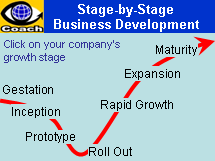
Gestation Inception Pilot Stage Roll out Rapid Growth Expansion Maturity

Managing the Five Risks you face at all stages of your business development:

  1. growth risk

  2. technology & production risk

  3. marketability & competing risk

  4. financial risk

  5. team & management risk

Turn Risks into Opportunities

Business Plan Pro


3.

Pilot Stage

- product development continues, significant expenses are incurred, but no product revenues generated

Organization: Informal

Management:  Entrepreneurial

Technology: Prototype

Funding Stage: Seed

pp.

Problem

Solution

Action

3.1

Growth Risk:

  • Company expansion requires professional business experience,  expertise and skills

  • Bringing project into a new environment

  • Meeting milestones and keeping in mind clear target dates

  • Work is proceeding according to plan

  • Changes in the company necessary for production and field testing of your product prototype

Discover New Solutions from our Affiliates

Managing a Small Business CD-ROM, a comprehensive guide and toolkit for starting and operating a small business, for just $50. Click here

  • Avoid the 10 deadly small business mistakes; learn 9 secrets to boost your small business performance

  • Make a Strength - Weaknesses - Opportunities - Threats (SWOT) analysis

  • Before launching the whole show, launch a little piece of it

  • Convene a focus group to test the product, build a prototype and watch it perform, conduct a regional or local rollout of a service. Such an exercise reveals the true economics of the business and can help enormously in determining how much money the new venture actually requires and in what stages.

  • Set the direction and stay the course

  • Explore the opportunities to set up your pilot plant in an enabling environment (business incubator, S&T park, etc.)

  • Use external professional advice

  • Hire new people and train them

  • Check and update your business plan and business concept

  • Prepare for developing a flexible and responsive lean production system and value chain at your company

3.2

Technology Risk:

  • Bringing technology into a new environment from prototype to the pilot stage

  • Not developing meaningful, unique product attributes

  • Translating the product functional specifications to the internal workings (design specifications)

  • Going for a simple, not perfect solution. The main objective is to get market feedback and adjust your business plan accordingly

  • Prepare a feasibility study

  • Keep faithful to the product functional specifications

  • Start developing production processes and relationships with suppliers and customers

  • Test, evaluate and debug your technology

  • Develop an intellectual property management system (see slide show)

  • Make a value analysis

3.3

Marketability Risk:

  • Lack of identity and brand awareness

  • Market response to the product is below expectations

  • Competitors respond more fiercely than expected

Selling is not about content. It is about finding a "fit". Revise both your product values and your marketing strategy.

  • Define who your customers are and how they make decisions about buying products or services; to what degree your product and marketing plans fit into their purchasing behavior

  • Develop commercialization and market entry strategy

  • Test market your product or service; identify the price at what you could sell it

  • Correct your product development and marketing strategy based on the feedback received

  • Make a sales forecast

3.4

Financial Risk:

No product revenue generated yet though significant expenses incurred and more cash required for working prototype development 


To raise venture capital you need:

3.5

Team & Management Risk:

  • Over-response to opportunities can lead to fragmentation and burn-out

  • Difficult to find a substitution in case one of venture leaders leaves the company

  • Resisting development of structure, processes and controls

  • Continuous evaluation

  • Delegating to gain control

  • Change from reactive to proactive style

  • Development of an effective motivation system for the entrepreneurial team

  • Employ modern venture management approaches

  • Set the direction and stay the course

  • Hire multi-talented people with your values

  • Move with speed leaving details for later

  • Start developing processes

  • Develop plans for the future

  • Begin to build structure and controls

  • Develop effective compensation program for your team members; study the opportunity of sharing company ownership with them

  • Delegate roles/responsibilities

  • Track key indicators

Founder - Vadim Kotelnikov. © Copyright by Ten3 East-West.  | Copyright | Glossary | Links | Site Map |

Contact info   Check what we can do for you   Advertise   Partner with us   Become an Author   Become a Sponsor