|
|
21 Secrets
of
Self-made Millionaires |
|
|
|
 Humorous
Business Plan
Humorous
Business Plan
Smart
Success |
Brief History:
"Success
is often the result of taking a misstep in
the right direction."
–
Al Bernstein...
Growth
Strategy: "The
way to succeed is to double your failure rate."
–
Thomas J. Watson. |
|
 |
Pearls of Wisdom |
|
East
Failure is the foundation of success, and the means by
which it is achieved.
~
Lao Tzu
Be not ashamed of mistakes and thus make them crimes.
–
Confucius
Freedom is not worth having if it does not
include the freedom to make mistakes.
– Mahatma Gandhi
Many people dream of success. To me success can only
achieved through repeated failure and introspection. In fact,
success represents the 1% of your work that results from the 99%
that is called failure.
– Soichiro
Honda
West
That which does not kill us makes us stronger.
–
Friedrich Nietzsche
Sometimes life hits you in the head with a
brick. Don't lose faith.
–
Steve Jobs
I have not failed 700 times. I have not failed once. I
have succeeded in proving those 700 ways will not work. When I have
eliminated the ways that will not work, I will find the way that
will work.
– Thomas Edison
I have learned
throughout my life as a composer chiefly through my mistakes and
pursuits of false assumptions, not my exposure to founts of wisdom and
knowledge.
– Igor Stravinski
Once you embrace unpleasant news not as
negative but as evidence of a need for
change, you aren't defeated by
it. You're learning from it.
–
Bill Gates |
|
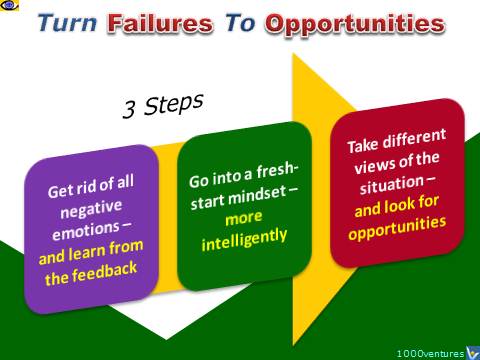
Turning Failures To
Opportunities
3 Steps |
-
Get rid of all negative
emotions – and lean: There is no failure, only
feedback!...
More
|
|
50 Rules of Project Management |
-
If at first you don’t succeed, remove all evidence you ever
tried.
-
The nice thing about not planning is that failure comes as a
complete surprise rather than being preceded by a period of worry
and depression
|
|
Prevent Failures
You can prevent failures. Failure is the result of
interactions in a system. It has structure and sequence. Once you
understand how the system is working structure things
differently, so you can avoid 'failure' again in the future...
More
Noble Failure
as a
Primary Vehicle for Success
In
→
Innovation
and
→
Change
efforts, it is only by trying lots of
initiatives that you can improve your chances that one of
them will be a real
breakthrough.
→
Noble Failure provides a great
learning opportunity and should be
viewed as a very lifeblood of success.
>>>
Innovators,
intrapreneurs and
change leaders must have
freedom to experiment
and, naturally,
→
freedom to
fail
 because experimentation is about moving into an unknown territory.
According to
→
NLP,
there is no failure, only feedback.
>>>
Actually,
it is only through seeming failures that most of greatest successes in life
and business are achieved. Like beauty, "failure" or "success" is in the eye
of the beholder. If you fall short of reaching a goal, ask
→
Learning
SWOT Questions
and see how you can emerge stronger from this experience. How can you
prevent such failures in
future? Can you turn this "failure"
to an opportunity? How
could this "failure" and the lessons learned from it be turned to a longer
term success?
How To Prevent
Innovation
(Humorous
Tips)
 Inspirational Business Plan:
Successful Innovation
Brief History:
"I have not failed 700 times. I have not
failed once. I have succeeded in proving those 700 ways will not work.
When I have eliminated the ways that will not work, I will find the way
that will work."
–
Thomas Edison..
Steve Jobs' 12 Rules of Success
-
Learn
from failures. Sometimes when you innovate, you make
mistakes. It is best to admit them quickly, and get on with improving
your other innovations...
More
The Art of Innovation: 9 Truths
By: Guy Kawasaki
Don't worry, be crappy.
An innovator doesn't worry about shipping an innovative
product with
elements of crappiness if it's truly innovative. The first
permutation of a innovation is seldom perfect – Macintosh, for
example, didn't have software (thanks to me), a hard disk (it
wouldn't matter with no software anyway), slots, and color. If a
company waits – for example, the engineers convince management to
add more features – until everything is perfect, it will never ship,
and the market will pass it by.
Why Businesses Fail...
Turning Failures To Opportunities...
Positive Thinking...
Pursuing Opportunities Faster than
Competition...
Fast Experimentation...
Freedom To Fail...
Creative Problem Solving...
Energizing People...
|