|
Why Knowledge Management?
"Knowledge is of two kinds. We
know a subject ourselves, or
we know where we can find
information upon it."
~ Samuel Johnson
While most managers agree that managing
knowledge is important, few of
them can articulate what the value is or how to become a
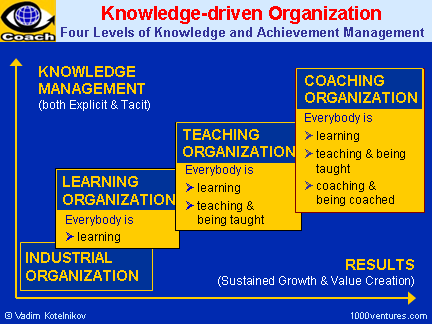
learning,
teaching, or
coaching organization.
The majority of companies have their
knowledge
embedded in people and organizations.
Knowledge needs to be managed because all too
often,
it is available but not used very much
it is
often
intuitive,
tacit, rather than explicit
>>>
it is
occasional but not integral to the business
it is rarely detailed enough to be
especially valuable
it exists with multiple points of view instead
of the collective
best thinking
it often gets lost when someone leaves the
company
there are
human
barriers to knowledge transfer.
KM vs.
Information Management
"Knowledge management" is different from
"information management". While the former targets collecting and
distributing knowledge – both explicit and
tacit – throughout the organization, the latter deals mainly with
documented explicit knowledge – or information – only...
More
Transfer of Best Practices
Transfer of
best practices is one of the
biggest issues driving innovation, cost,
efficiency, and satisfaction in
most companies. Transferring the worst practices and practitioners is
equally important as individuals who make the same mistakes over and over
again are like a human version of a computer virus.7
Idea Management
Idea management systems and process can help
your company
make innovation a discipline.
They can help make the hunt for new possibilities each and every
department's business, as well as involve broader and more enthusiastic
participation among managers and employees...
More
Tacit Knowledge as a Source
of Competitive Advantage
Tacit knowledge, or implicit knowledge, as opposed
to explicit knowledge, is far less tangible and is deeply embedded into an
organization's operating practices. It is often called 'organizational
culture'. "Tacit knowledge
includes relationships, norms, values, and standard operating procedures.
Because tacit knowledge is much harder to detail, copy, and distribute, it can
be a sustainable source of
competitive advantage...
What increasingly differentiates success and failure is how well you locate,
leverage, and blend available explicit knowledge with internally generated tacit
knowledge."3 Inaccessible from explicit expositions, tacit knowledge
is protected from competitors unless key individuals are hired away...
More
Ask Searching Questions
Don't ask one or two questions and then rush straight towards a solution.
With an incomplete understanding of the problem it is very easy to jump to
wrong conclusions.
Ask open-ended questions that elicit a wide rage of answers:
(see
an example)
Making an Internal Market in Knowledge
One source of competitive advantage
is to diffuse throughout your company the unique, proprietary knowledge
about customers, competitors, products, and techniques that resides in the
minds of your employees. But many efforts at knowledge management have
failed to deliver that advantage, because they haven't focused on the human
factors of
creation and broad exchange of knowledge within a company. Establishing
an internal knowledge market with its own unique approaches to
motivation, pricing,
exchange, market facilitation, and competition can solve that problem and
boost productivity. It is less about investing in technology than about
encouraging authors to "sell" their valuable knowledge and other employees
to "buy" it within a market that ensures its quality.11
|