Full Version


Systemic Innovation:

Lateral Thinking

Building Your Cross-Functional Excellence

Knowing how to transform stand-alone ideas, technologies, products and services into value-rich solutions

By: Vadim Kotelnikov

Founder, Ten3 Business e-Coach Inspiration and Innovation Unlimited!


"You can't do carpentry, you know, if you only have a saw, or only a hammer, or you never heard of a pair of pliers. It's when you put all those tools into one kit that you invent." Peter Drucker


Building Your Cross-functional Excellence Vadim Kotelnikov Leader of Business Synergies (S-LEader) Leadership People Skills Entrepreneur Business Models Management Business System Sustainable Growth Enterprise Strategies Enterprise-wide Business Process Management (EBPM) Innovation Management Marketing & Selling Competitive Strategies Systemic Innovation Corporate Leader Synergies Cross-functional Excellence / Cross-functional Expertise

The GE Leadership Effectiveness Survey (LES)

  • Demonstrates broad business knowledge / perspective with cross-functional / multicultural awareness... More

Pearls of Wisdom

 East

The mind, sharp but not broad, sticks at every point but does not move.

Rabindranath Tagore

We join screws in the wheels, but it is the hole in the wheel that drives the vehicle.

Lao Tzu

I see true innovation to be made up of three 'creativities' – creativity in technology, product planning, and marketing.

Akio Morita

 West

You can't do carpentry, you know, if you only have a saw, or only a hammer, or you never heard of a pair of pliers. It's when you put all those tools into one kit that you invent.

– Peter Drucker

Most great ideas are really combinations of other ideas.

– Paul Sloane

The simple secret of my genius is that I created something new out of the ideas and inventions of others.

Henry Ford

6Ws of Sustainable Growth Pursuing Opportunities Fast Company Strategic Management Sustainable Growth Customer Value Creation Corporate, Vision, Mission, Goals Shared Values Sustainable Competitive Advantage Enterprise-wide Business Process Management Innovation Management Marketing and Selling Corporate Leader Team Building and Teamwork Customer Partnership Vadim Kotelnikov Change Management Market Research Know WHAT: Balanced Business System Know HOW: Business Model Enterprise Strategy People Power Sustainable Value Creation Road-mapping Strategic Leadership Corporate Capabilities Competitive Strategies Winning Organization Management Employee Empowerment Partnerships Sales Success

Build Your Cross-Functional Excellence

to Achieve Your Objectives:

As a Corporate Leader and a Business Architect:

SMART EXECUTIVE (Ten3 Mini-course)


As an Innovation Project Leader

As an Entrepreneur (in the broad sense of this word)

Cross-Functional Technology Managers

  • are skilled technologists

  • value the contribution from other functions

  • play an active role integrating these functions during the innovation process

Maintaining a Fresh Perspective with Your Employees

10 Tips

  1. Encourage employees to learn a variety of skills and develop cross-functional excellence... More

How To Lead Creative People

By: Max DePree

  • Creative people need diverse experiences to do their work... More

Case in Point

Attributes of the Super Smart Sought by Microsoft

Best Practices

HP Values

  • We attract highly capable, diverse, and innovative people and recognize their efforts and contribution to the company.... More

Why Do You Need Cross-Functional Excellence?

Innovation is a pervasively cross-functional process. Although innovation is driven by technology, required competence extends beyond technical know-how. In the new knowledge economy and knowledge-based enterprises, systemic innovative solutions arise from complex interactions between many individuals, organizations and environmental factors.


The boundaries between products and services fade rapidly too. If you wish to be a market leader today, you must be able to integrate in a balanced way different types of know-how that would transform stand-alone technologies, products and services into a seamless, value-rich solution.

10 Commandments of Innovation

Synergize. Build your cross-functional expertise and systems thinking skills... More

No Idea is Wasted!

Your mind can accept only those ideas that have a frame of reference with your existing knowledge. It rejects everything else. If your knowledge is functionally focused, you'll be open to new ideas related to your functional expertise only and will miss all other learning and innovation opportunities.

If you develop a broad cross-functional expertise, no new idea is wasted. It will immediately connect with the existing knowledge and inspire  you, energize you, and encourage your entrepreneurial creativity. The broader your net, the more fish you can catch.

The Danger of Categorization

"It's a pity nature isn't divided into the same categories as universities."

We need categories to be able to handle the huge amount of information we use and control.

That's why we have a hierarchy of folders and files in our computer, and that's why universities are categorized into faculties and departments. Categorization helps you, but can also prevent you from using what you know about one field in another.

There is a well known problem in education called the transference problem. If you teach something in one context, students most likely will not be able to use that knowledge in another6 and build synergies... More

Combining the Unusual

The vast majority of new ideas are not original but derived from something else. Most great ideas are really combinations of other ideas.4

When asked about the secrets of his success, Henry Ford answered, "The simple secret of my genius is that I created something new out of the ideas and inventions of others."

Learn Playing More Than One Note


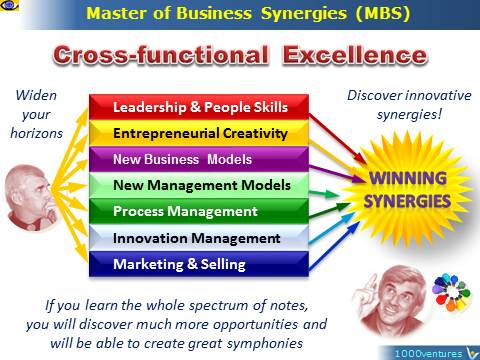
If you learn not one, but the whole spectrum of notes, you will not have to play mono-tone music all the time. Your will discover much more opportunities and, by engaging your lateral thinking, self-motivation, and systems thinking arts and skills, create great symphonies and improvise whenever necessary.

Leading an Organization

We all start our careers as specialists – men and women with narrow corridors of functional expertise. The goal of specialists is to optimize individual effort. Technologists want to design the best products. Salespeople want to develop the most effective marketing strategies... and on and on. But "to raise to the ranks of senior management, you must forgo this quest for personal perfection, seeking instead to balance the skills and capabilities of the specialists working for you."1 You need to apply the balanced business system approach and consider your business as a system of interrelated factors of strategy, owners, investors, management, workers, finance, processes, products, suppliers, customers, and competitors.

Strategic Cross-Functional Management

Strategic cross-functional management is central to capitalizing on functional excellence, and in order for functional specialists to make the greatest possible contribution, they must take a broader view of their functions and understand how they fit into the web of the organizational processes and, ultimately, into the overall strategy... More

Value Chain Management

Making breakthrough improvements in your value chain requires out of the box, cross-functional, systems thinking.  You have to see the value creation process across the entire flow of work, not just single points... More

Driving Radical Innovation

"Here is the paradox: You need a great team of people with diverse skills to perform a symphony well, but no team has ever written a great symphony!".3

While cross-functional teams are key players in defining and implementing incremental innovation projects, cross-functional disruptive individuals tend to be key players in defining radical innovation projects. Individuals who are likely to excel in a radical innovation project, besides having superior technical capabilities, should be goal-oriented, broadly educated, creative, extremely bright, not afraid to be different, integrative, flexible, passionate, entrepreneurial, aggressive, eager to learn business, able to take risks, and inquisitive.3

Managing Technology


In the new era of systemic innovation, cross-functional technology managers are in high demand. In the Silicon Valley, for instance, many companies found that when they moved to a flatter organization, they had plenty of top-flight technologists but too few technology managers. "These managers are skilled technologists who also value the contribution from other functions, and who play an active role integrating these functions during the innovation process".2

Managing Knowledge

The explosion of knowledge growth, combined with its rapid distribution, makes it difficult to stay on top of the available knowledge in any industry. Thus, a global knowledge economy rewards not only creators of new knowledge but also those who can identify and integrate knowledge effectively.2

 Case in Point  The Rise of the IT Architect

IT architects are in growing demand.  They are cross-functionally excellent people who can "tie several silos of expertise together," relate to business problems as well as technology, and then sell their ideas upward and downward in the corporate hierarchy. The position of IT architect has become increasingly important to the ever-changing IT industry, and is one that established corporations and start-ups are seeking.

"As IT positions become more specialized and include increasingly detailed responsibilities, there's a need for someone who can tie several silos of expertise together," says Al Volvano, a product manager for Microsoft's Learning Group. "Enterprise architects aren't just technology experts; they are leaders with broad IT knowledge, the savvy to apply it to business problems and the communication skills necessary to coordinate the people who will put their plans into action," says Bill Liguori, senior vice president and co-founder of the placement firm Leadership Capital Group.7

 Case in Point  Microsoft

Bill Gates believes that the greater the human "bandwidth" that he employs (in other words, collective intelligence Microsoft hires and develops), the greater the strength of his company. Narrow-minded technologists have never fitted Gates' broader ambitions. Gates uses the word "bandwidth" to describe people's intellectual capacity... More

 Case in Point  Ten3 Business e-Coach

Ten3 Business e-Coach, a new-to-the-world product and the world leader in business e-coaching is a great illustration of the power of cross-functional expertise as a source of sustainable competitive advantage.  The e-Coach integrates synergistically and systemically many various expertises to inspire innovation and entrepreneurial creativity. Launched in 2001 initially as  a hobby and later on as a home business, by 2005 it has customers in more than 70 countries. This global success created no direct competition to Ten3 Business e-Coach however. Why? Because potential me-tooers had no cross-functional experts to develop a competitive systemic e-coaching service and keep upgrading it continuously with the same speed.


 Discover much more in the

FULL VERSION of e-Coach

Thriving in a Complex Business Environment...

Advanced Management Program (AMP)...

Managing Rapid Growth...

Real-time Business Development...

Diverse Routes to Innovation...

Strategy, Product, and Process Innovation...

Leading Innovation...

Value Innovation...

Business Innovation...

Organizational Innovation...

Creative Marketing...

The Power of Taking a Different View...

Entrepreneurial Creativity...

Managing Innovation by Cross-functional Teams...

 Case in Point  IDEO...

 Case in Point  AT&T: Developing New Credit Card Service...

 Case in Point  Silicon Valley Companies...

 Case in Point  Genetics...

Case in Point  Printing Press...

Case in Point  Hewlett-Packard...


References:

  1. "Extreme Management," Mark Stevens

  2. "Relentless Growth," Christopher Meyer

  3. "Radical Innovation," Harvard Business School

  4. "Lateral Thinking Skills," Paul Sloane

  5. "The Coming of the New Organization," Peter Drucker

  6. "ASIT Technique – Creativity and Inventive Thinking," Roni Horowitz

  7. "The Rise of the IT Architect," Ryan DeBeasi

  8. SMART Executive, Vadim Kotelnikov

  9. SMART Business Architect, Vadim Kotelnikov

  10. Entrepreneurial Creativity, Vadim Kotelnikov

  11. 6Ws of Corporate Growth, Vadim Kotelnikov

  12. Systemic Innovation, Vadim Kotelnikov

Developing Yourself

Lateral Thinking

How To Be More Creative

Corporate Leader

Cross-functional Management

Switching Responsibilities

Business Architect

Systems Approach to Management

Systemic Innovation

Systems Thinking

Systemic Thinking

Leveraging the Power of Diversity

Radical Innovation

Radical Innovation vs Incremental

Knowledge Management

Idea Management

Managing Tacit Knowledge