| |
|
Creativity in Groups and
Cross-Functional Teams
|
|
 |
 |
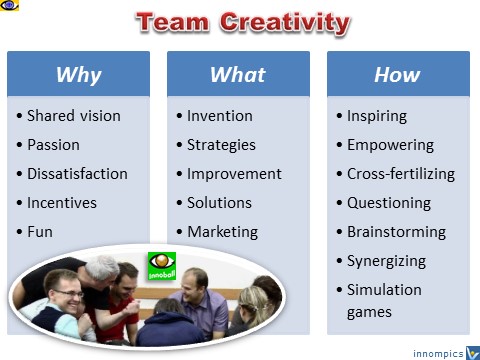
Formulate a compelling WHY and a
creative
HOW will follow.
~
Vadim
Kotelnikov |
|
Without strategic alignment,
ideas flutter like butterflies.
An inspiring big dream makes
ideas line up in a pyramid aimed
at the dream result.
|
|
|
|
|
While
individual creativity is highly important to
business, the creativity of groups is often even
more important in today's era of
systemic innovation. The creation of today's
complex systems of products and services
requires the merging of knowledge from diverse
disciplinary and personal perspectives. and
crosspollination of ideas. Leading companies
synergize
diversities and innovations. |
|
| |
Innovation – whether it be revealed in
new products and services,
value innovation, new processes, or new
business models – is rarely an individual
undertaking. Creative cooperation and
cross-pollination of ideas, and
creativity management are all critical. |
|
 |
| |
The
tacit dimensions of their knowledge bases
make such individuals especially valuable
contributors to
innovation projects; perspectives based on
such knowledge cannot be obtained any other way
except through interaction. |
|
 |
 |
|
Just hearing a
very different perspective challenges the
mindset of others sufficiently that they will
open their mind to new discoveries and search
beyond an obvious solution. This is a reason
why intellectually heterogeneous
cross-functional teams are more innovative than
homogenous functional ones. |
|
 |
We bring together the best ideas –
turning the meetings of our top managers into intellectual orgies. |
Jack Welch
GE |
|
 |
Great groups are more optimistic than
realistic. They believe they can do what no one else has done
before. |
Tom Kelley
IDEO |
|
|